
By Wylie Saviello
The Guana estuary and wetlands along A1A in St. Johns County are beloved by the Northeast Florida community. While the land may be protected from development, the future of the water’s health remains uncertain.
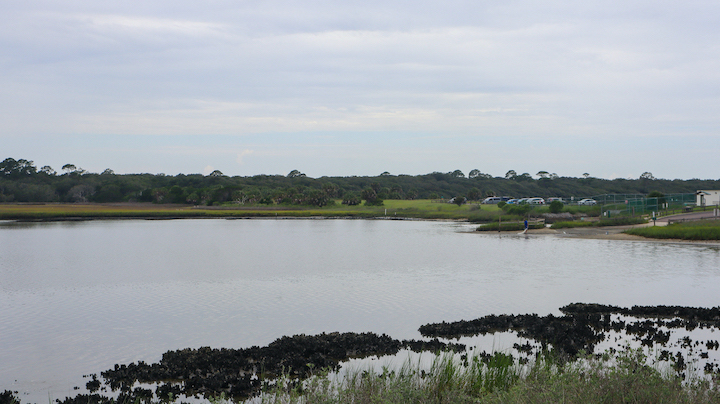
Guana’s 76,000 acres of land and water from Ponte Vedra to Palm Coast create a unique and crucial variety of wetland and upland habitat for Florida’s wildlife. It is home to oysters, osprey, bald eagles, falcons and gopher tortoises. Guana is a special place for people, too, offering space for hiking, biking, fishing, kayaking and birdwatching.
As excess nutrients from nearby land development pollute the waters feeding into the estuary, Guana faces water quality challenges that concern researchers as to how these pollutants can negatively impact the environment of such a vital wild area.
Estuaries are where the river meets the sea, and are uniquely important natural ecosystems. They support clean water, abundant wildlife and recreation, while also protecting homes, businesses and infrastructure from the impacts of flooding and climate change, according to GTMNERR.org. The Guana estuary is home to an abundant oyster population that plays a key role in water quality by filtering 60% of Guana’s water every two weeks, according to Florida Aquatic Preserves.
In spring of 2025, the state of Florida was considering a land swap with a company called The Upland LLC. This land swap would have given Upland 600 acres of key wildlife habitat inside the Guana River Wildlife Management Area and, in return, given the state 3,000 acres of land divided across four counties.
The public outcry at such a large-scale swap of crucial protected public land was heard across the state.
Protesters staged demonstrations near Guana opposing the land swap and to voice their concerns. More than 50,000 people signed a petition to prevent the land swap, according to State Representative Kim Kendall in a First Coast News article. The quick mobilization of the community’s efforts to protect Guana was successful, and the application for the land swap was withdrawn by The Upland LLC.
“Our community understands the value of protecting the Guana Estuary. The threat of the land swap galvanized the community and we became a united front to save it,” said Linda Krepp, longtime resident and former GTMNERR environmental educator and Friends of the GTM board member.
The GTM Research Reserve is a living laboratory including the Guana River Wildlife Management Area (WMA), aquatic preserves, and other conservation lands. The GTM Research Reserve is one of 30 National Estuarine Research Reserves (NERR), and is the broader organization that conducts research in this area of wild land. The reserve boundary includes 12 distinct management units and is home to two Aquatic Preserves: Guana River Marsh Aquatic Preserve and Pellicer Creek Aquatic Preserve.
What made the land swap additionally concerning to many is that the Guana River is an Outstanding Florida Water (OFW), meaning it is designated as worthy of special protection because of its natural attributes. This designation is intended to protect existing good water quality, according to the Florida Department of Environmental Protection (FDEP).
Water quality issues
But while the land in Guana Wildlife Management Area is safe for now, there are still significant concerns about the water.
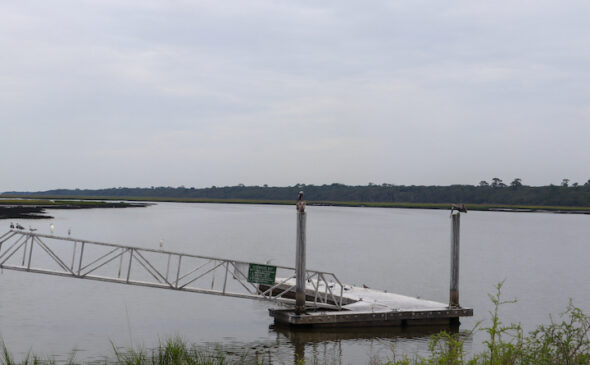
The headwaters of Guana Estuary start in Ponte Vedra, from which water flows south into Guana Lake. Guana Lake is a shallow reservoir created by the Guana Dam, which is managed primarily for waterfowl hunting. When the dam is open, water continues to flow south into the Guana River.
Despite being designated as an OFW, the Guana Estuary has poor water quality, suffering from excess nutrient pollution that can lead to eutrophication. This occurs when an environment becomes over-enriched with nutrients, increasing the amount of plant and algae growth in the estuaries and other bodies of water.
Extensive research and data from the GTMNERR suggest the excess nutrients are overwhelmingly coming from headwaters.
“The headwaters of the Guana Lake is Ponte Vedra Beach, where the land is developed. Excess nutrients from fertilizer runoff and reclaimed wastewater from communities and golf courses to the north appear to be contributing to the water quality impairments in the Guana Lake to the south,” Krepp said.
Fertilizer feeds lawns, but it also feeds algae. Nitrogen and phosphorus are found in fertilizers used on lawns that easily run into waterways, polluting the water with excess nutrients.
Excess nitrogen and phosphorus are the main nutrients polluting Guana’s waters. Nutrients are essential for the growth of algae and aquatic plants, but when large amounts enter the water, it causes algae to grow out of control. These algal blooms are harmful because they can kill fish and seagrass, as well as reduce essential fish habitats, according to the National Oceanic and Atmospheric Administration (NOAA).
A multi-year study by the GTMNERR analyzing the Guana Lake/Guana River system in Northeast Florida established a baseline of water quality conditions for this area.
This study found that there is a north-to-south salinity gradient in the Guana estuary, with freshwater in the northern reaches, brackish water in the center, and saltwater in the south. Similarly, there is a north-to-south gradient with sucralose, an indicator of human wastewater originating north of Mickler’s weir. The research team also found that nutrient and phytoplankton concentrations were generally higher in the lake than in the river.
Dissolved oxygen is an important indicator of habitat quality for aquatic organisms as it represents the oxygen available to aquatic organisms for breathing. This study observed low levels of dissolved oxygen in Guana Lake, which is stressful to the aquatic organisms living in these waterways.
Stormwater ponds
Stormwater retention ponds can be an important tool in managing stormwater runoff in urban areas, but without proper management, they fail to serve their purpose as a filter for pollutants.
Stormwater ponds are specially designed to collect runoff from developed areas and filter out pollutants before they enter nearby waterways. However, their true purpose is often neglected and they become managed for maintaining aesthetics in urban areas.
The plants that surround stormwater retention ponds are imperative to their functioning because they help trap pollutants, like excess nutrients, before they enter the pond. But when neighborhoods mow up to the edge of the pond, cutting down key vegetation, they undermine the pond’s ability to catch pollutants and increase the amount of runoff that can enter the pond.
The Guana Estuary and other waterways suffer from copper pollution. The most likely source of this pollution is stormwater ponds.
Excess copper in estuaries is acutely toxic to aquatic organisms and threatens bivalves like oysters and mussels, which are vital for maintaining water quality through their filter-feeding and denitrification activities.
“Healthy oyster populations in the Guana Estuary are key to keeping our waters clean since oysters filter out nutrients and pollutants that enter our waterways. Think of an oyster as Mother Nature’s quiet filtration system. Oysters are our little heroes of the estuary,” Krepp said.
Copper-based algaecide is often dumped into stormwater retention ponds to kill algal blooms for aesthetic purposes. When stormwater ponds discharge into natural waterbodies, this copper then ends up in the estuary and can lead to gill damage, reduced growth, and even death in aquatic species. Copper sulfate may be a functional algaecide, but it doesn’t permanently eliminate algal blooms or treat the underlying issue — excess nutrients.
“Using chemicals to treat a problem in our water can have adverse consequences. The concentration of copper required to kill the algae and the concentration that is toxic to the aquatic organisms living in the water is very narrow. This can be a classic case of what makes it good can also make it bad … So it’s a fine balance,” Krepp said.
Restoration options
Not all hope is lost. The Guana Estuary’s water quality has not passed the tipping point, but researchers and activists say action must be taken now before the water quality declines even further.
Managing nutrient pollution is one way to aid in restoring Guana’s water quality. The Guana Estuary watershed that lies above the Mickler’s weir is 19% natural land and 81% developed land, according to a study published in the July 2025 Marine Pollution Bulletin that assessed the Guana Estuary’s water quality. Of this 81% of developed land, 55% is categorized as highly developed. These staggering numbers illustrate serious threats to the Guana System’s environment because these developed lands contain golf courses, a wastewater treatment facility and private lawns that are highly manicured with harmful chemicals and fertilizers.
Development throughout Florida is not slowing down, and neither is the nutrient runoff. Researchers say it is critical that new methods be considered for managing nutrient loads and stormwater runoff to preserve the Guana Estuary. According to research led by Dr. Ashley Smyth, assistant professor of biogeochemistry with the University of Florida, there are several actionable recommendations for water quality restoration available.
Limiting fertilizer use during rainy summer months and upgrading wastewater infrastructure are methods that can be used to reduce nutrient loading, but they must be executed soon to protect the water quality from dropping any further.
Harvesting in-lake vegetation is another way to restore Guana’s water. Currently, vegetation in the upper reaches of Guana absorbs some of the nutrients, but when the vegetation becomes too thick, it is sprayed or flooded with salt water to kill it. This process of killing the vegetation leads to decomposition, which releases the nutrients back into the water, polluting it once again.
If the vegetation is physically removed, or harvested, instead of killed and left to decompose, that would directly remove the nutrients and prevent further nutrient pollution in the water. However, this option can be cost-prohibitive, making nutrient reduction upstream even more important.
Community not only plays a role in protecting wild areas like Guana from development, but also is key to improving these protected areas. People showed up and spoke out against the Guana Land Swap; now researchers and activists hope the community can do the same to restore the water.
“The Guana Estuary is teeming with life. When our behaviors affect even the smallest of creatures in the estuary, it causes a chain reaction throughout the entire system, including the blue crabs, shrimp, and redfish that locals value so highly. As we pull at one thread in our environment, it has consequences down the line, which ultimately affects all of us,” Krepp said.
To restore the health of the water and essential habitat of the Guana River and Lake, activists encourage community members to email St. Johns County commissioners and urge them to adopt a restoration plan for Guana’s water quality. Researchers and activists say a serious and thorough restoration plan is vital to restoring the water of such an ecologically valuable area.
“Keeping Guana’s waters healthy is key to the health of our community. And, that’s something we can all get behind,” Krepp said.

Be the first to comment on "Guana’s land may be protected, but the future of its water is uncertain"