
By Wylie Saviello
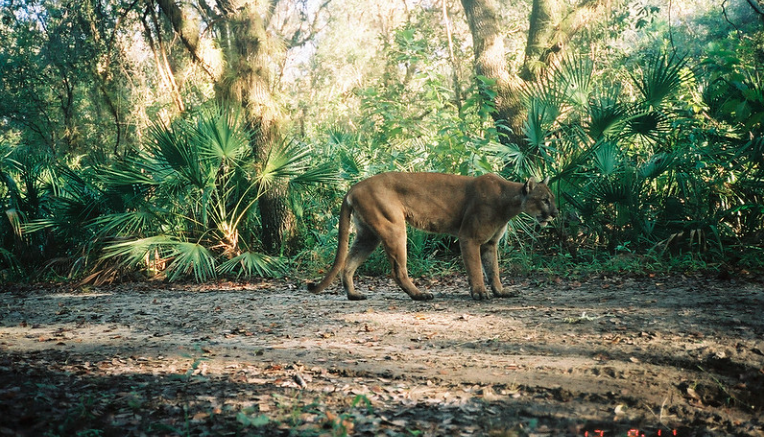
In June alone, three Florida panthers were killed from vehicular collisions in southwest Florida. Just over a month prior, a two-month-old panther was killed by a vehicle strike- one of the 11 total panthers that have died in 2026- all from “Vehicular Trauma,” as sited in the Florida Fish and Wildlife Commission’s database.
The Florida panther has come a long way, with the population rebounding from an estimated low of 10 animals to over 200 animals since it was first included on the Endangered species list in 1967, according to the U.S. Fish and Wildlife Service’s website. But panthers need a lot of space, and urban sprawl limits their ability to inhabit large territories, putting vehicles at the top of the list for panther deaths.
Florida is one of the fastest growing states in the country, but it has one of the highest numbers of federally endangered and threatened species. Whether it’s panthers, the Anastasia Island Beach Mouse or other endangered species like the Florida scrub jay, Florida’s wildlife across the state is dealing with challenges arising from development and increased human presence in their habitats.
“About 90% of [the Florida scrub jay’s] scrub habitat has been lost. And what remains is increasingly fragmented,” said Audrey DeRose-Wilson, Director of Bird Conservation for the National Audubon Society’s Florida chapter.
Recent changes to the Endangered Species Act under the Trump administration address the definition of “harm” and what it means to “take” an endangered animal. Wildlife conservation groups say these changes lessen protections for threatened and endangered species across the nation, including species unique to Florida who already face significant threats.
The administration revised the definition of “harm” to no longer prohibit the “modification or degradation” of a habitat. They also recently began the process of redefining what it means to “take” an endangered animal, proposing a new interpretation of the law’s language that would no longer consider the accidental killing or injury of an animal illegal, according to an internal memo obtained by the New York Times.
“We are tracking these changes occurring at the federal level. It takes some time for the policy change at the federal level to trickle down to local level decisions,” said Michael Lagassé, Environmental Division Manager of the St. Johns County Growth Management Department.
It’s unclear exactly how these changes at the federal level will affect local species, but St. Johns County officials expect some impacts.
“With the change to the definition of harm in the Endangered Species act, there could be effects to some local regulations… I expect the “harm” rule change and pending “take” rule changes will have long-term effects on how certain regulatory protections are enforced, but at current, we are moving forward and focusing on our local and state regulations,” Lagassé said.
Conservationists see these changes as a removal of protections for threatened species habitats, making it more difficult to designate these habitats as “critical” and allowing increased opportunity for development, including harmful drilling and mining. These changes in policy modify how the law addresses habitat destruction in the actual injury or death of threatened and endangered wildlife. They also alter legal enforcements for unintentional killing or harm to endangered species, putting animals further at risk.
This spring, several conservation groups filed a lawsuit against the U.S. Fish and Wildlife Services and U.S. Army Corps of Engineers for authorizing a 10,000+ acre development project within the panthers’ occupied breeding habitat in Collier County, Florida, according to a press release from the Center for Biological Diversity.
Environmental groups quickly assembled a lawsuit opposing the rule change for being a “decision that contradicts all scientific and legal understanding of the importance of habitat to America’s most vulnerable plants and animals,” according to the center.
Florida’s shorebirds and seabirds are at risk, too, as development and fragmentation isolate their populations.
The Florida scrub jay is a federally endangered bird species endemic to Florida, meaning it is found nowhere else in the world. This vulnerable bird species inhabits sand pines and oaks in the high and dry areas of Florida but is threatened by habitat destruction and fire suppression.
“Poorly planned development sprawl has a big impact on both [shorebirds and seabirds] … It’s really especially acute because they’ve lost so much of their nesting habitat and they’re increasingly concentrated in a small number of sites,” DeRose-Wilson said.
She manages Audubon Florida’s coastal stewardship program, which stewards coastal birds all the way from Pensacola in the Western Panhandle down to Naples. Scrub jays are also found in central Florida and in some stretches of habitat along the Atlantic coast. As they lose habitat to urban sprawl, they also lose critical management techniques to their remaining habitat.
“The scrub habitat that they live in is dependent on periodic resets from fire. As areas become more developed, smoke management is a big issue… and if there’s no place for the smoke to go, then it can become impossible to burn those areas and the habitat degrades further,” Derose-Wilson said.
Scrub jays are not migratory birds, with most not traveling more than a few kilometers from their birthplace, according to BirdsoftheWorld.org. This lack of disbursement over long distances reduces the opportunities for birds to move between populations, especially when options for viable habitats are becoming scarce.
“Scrub jays are home bodies, they stay put. These smaller isolated populations are more vulnerable, and often the mortality [rate] exceeds the reproductive success … so the populations decline,” Derose-Wilson said.
If these birds do try to disperse to another population, they must cross large areas of unsuitable habitat, making themselves vulnerable to many threats that come with such an expedition. But Derose-Wilson says there are ways to protect these species from becoming further endangered.
“One thing that people can do right now is vote ‘no’ on Amendment 3 on November’s ballot, which would reduce property taxes for many of Florida homeowners, but result in dramatic cuts to local services. This would be everything from community parks and flood controls to a lot of the things providing the last line of defense against sprawl with local governments,” Derose-Wilson said.
Another species suffering from habitat loss are sea turtles nesting on Florida’s beaches, but St. Johns County has regulations in place to protect them from a variety of human interferences they face during nesting season between March and October each year.
“For sea turtles, we coordinate with the FWC Marine Turtle Permit Holders to, for instance, keep the beaches closed until they have monitored and marked all nests,” Lagassé said. “We provide supplies and space for supplies. Any number of administrative support and physical on-the-ground support … We work with FWC on rescuing stranded turtles and with space for certain permit holders to do forensic data collection to build bodies of data via necropsies and the like.”
In fact, St. Johns County has recorded over 1,400 loggerhead nests along its coastline, breaking any record within the past two decades. Counties across the state have reported record high numbers of nests, but with recent rollbacks of ESA protections this recovery of sea turtle populations may be short-lived.
Unique to St. Augustine, the Anastasia Island Beach Mouse is now listed as federally endangered due to a significant loss in habitat. Beach and residential development are their primary threat, according to St. Johns County’s website on protected species.
These mice live in the sand dunes of Anastasia Island where they feed on sea oats and dune panic grass in their remaining undeveloped habitat. Their main predators are racoons, great-blue herons and snakes, but their lack of suitable upland habitat remains the key challenge for species.
These small mice previously inhabited around 50 miles of beach habitat on Anastasia Island, but are now restricted to a meager 4 miles of such habitat, according to FloridaStateParks.org.
To mitigate this habitat loss, the county is working to preserve and protect the remaining habitat for the Anastasia Island Beach Mouse.
“We work with FWC on monitoring [Anastasia Island Beach Mouse] habitat and we participate and facilitate dune access studies,” Lagassé said.
Relying on coastal dunes and dry upland habitats, gopher tortoises share the same threat of direct habitat loss. Gopher tortoises are globally listed as a critically endangered species by the International Union for the Conservation of Nature, as threatened under Florida state law, and are considered a keystone species in the state of Florida where both the tortoise and its burrow are protected under state law, according to the Florida Fish and Wildlife Commission (FWC).
Gopher tortoises live for many decades, even in the wild, and have seen their habitat shrink over time. Their primary threat is habitat loss through habitat destruction, fragmentation and degradation, particularly from urbanization and development, according to the FWC.
“Because high, dry ground is prized by developers, it’s led to a lot of that upland landscape being converted into housing, malls and stuff like that … so there has been a lot of habitat loss for gopher tortoises,” said Dr. Ben Atkinson, a herpetologist and associate professor of natural sciences at Flagler College.
The FWC’s Gopher Tortoise Management Plan focuses on habitat conservation and management, population management and monitoring and research. As development brings more roads and cars near tortoise habitat, the FWC advises Floridians to slow down and scan the shoulder for these slow-moving animals to reduce road mortality.
“What people are doing to help is critical … we’ve put these animals that have been around a lot longer than us in a position where they effectively need our help to see the next century. And that’s a hard pill to swallow,” Atkinson said.

Be the first to comment on "Changes to federal protections threaten already endangered Florida species"