

Story and photos by Emily Braunstein
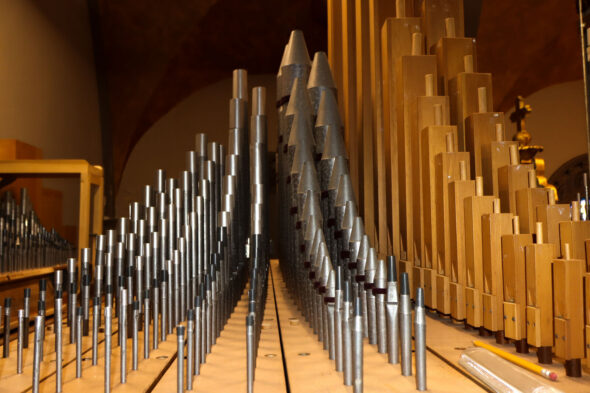
One of the most iconic sounds throughout history is the organ, referred to as the “King of all instruments” by Mozart. While almost all other instruments can be picked up and moved, the organ is unique in that it can consume entire walls of church, featuring towering pipes and thousands of tubes running throughout the building.
It takes both skill and coordination to play such a massive instrument — something that Matthew Daniel, Music Director and organist at the historic Memorial Presbyterian Church in downtown St. Augustine, demonstrates with precision and artistry.
“It’s really a transcendent experience on a Sunday morning just playing and then hearing the entire building just singing along,” Daniel said. “Pope, Benedict XVI said that it can almost emulate the whole realm of human emotions.”
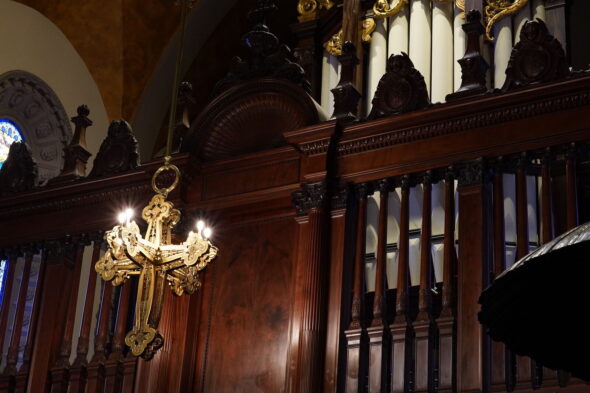
The Memorial Presbyterian Church houses the last large organ that Aeolian Skinner produced before they closed in the early 1970’s. The instrument and organist are covered by a wall of wood because Henry Flagler, the Standard Oil co-founder and railroad magnate, wanted the musicians to be heard, not seen.
Flagler also built the iconic Ponce De Leon Hotel, a National Historic Landmark that is the centerpiece of Flagler College and that sits across the street from Memorial. He has been called “Father of Modern Florida,” and in 2012, CNN included Memorial Presbyterian in a list of the top eight religious wonders to visit in the United States.
Daniel said playing behind the scenes is part of what makes his work at Memorial so special.
“In society, we see everything, but there’s some things that could be veiled and secret,” he said. “It’s kind of almost not seeing what’s going on, but just simply hearing it. It makes you appreciate it more and it’s almost a choir of angels coming down. I kind of like it being obscured.”
Organs are incredibly complex and intricate instruments. No two organs are alike because they are built for the specific space or church that they are in. Memorial Presbyterian required a larger instrument because of the wood wall, so their organ is much larger than both neighboring churches: Trinity Episcopal and the Cathedral Basilica.
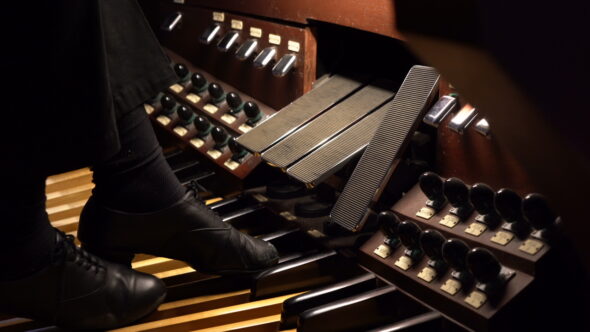
Daniel believes that the most difficult part of the instrument itself is the amount of coordination required. There’s a special set of shoes that every player has to have, specifically built for organists so they can feel their way around the pedal board without having to look.
“One of the most intimidating things for people coming that aren’t familiar with it is just simply this instrument’s size. It is a very large instrument,” Daniel said.
Daniel grew up on Fleming Island near Jacksonville. His grandfather was a pastor, and he was raised surrounded by music. Growing up playing his family’s church, Daniel naturally picked up on notes. His aunt got him a tiny toy keyboard, which led to the piano at age 3, the Hammond organ at age 10, and eventually the classical organ at age 17.
“I was always interested in music from when I was a baby, actually. My mom, dad and my grandparents all would tell me that when I was little, I just kind of gravitated to the musicians in church,” he said.
Throughout high school and college, Daniel worked at Catholic churches around the Jacksonville area, which led to him playing at Holy Family on Baymeadows for 10 years. Now, he has been playing at Memorial Presbyterian Church for two years.
“The organ really was where my heart was at,” he said. “I’ve always wanted it. So once I was tall enough to reach the pedals, that’s when I was able to jump into it and start doing more.”




Be the first to comment on "Memorial Presbyterian organist emulating whole realm of human emotions"