
By Holly Hearn
I made the best decision of my life when I was four years old.
I decided to go to the ballet and tap combo class at the dance studio near my house.
I don’t remember making that decision – it was more made by my parents after I really enjoyed a kids dance class at the library – but the decision to go to that dance class in September 2009 would define every day of my life that followed.

I went on to take countless classes at that dance studio until my senior year of high school. I spent more hours at my studio than my house. I saw my teachers more than my parents and my peers were the sisters I never had. I was considerably more sad to leave my dance studio than to leave my hometown for college.
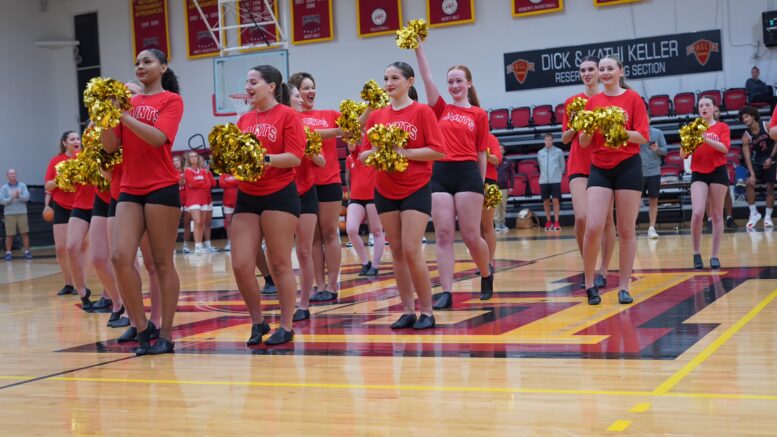
My fun fact at the beginning of each semester is that I am a dancer, and now in my junior year, I sometimes spend more time being the co-captain of Flagler’s dance team than doing my homework. I still view myself as more of a dancer than a journalist, despite being three semesters away from starting my career.

It feels like being a dancer is all I know.
This is a common feeling for all athletes. According to a 2024 study for the Journal of Applied Sport Psychology by Anna Farello, Maya Trajkovski and William V. Massey, there is a pressure to conform to a performance narrative in sports culture and ignore identities outside their sport.
This same study shows that this pressure leads to mental health issues – namely depression, eating disorders, anxiety, sleep problems and self-harm – for female athletes.
The pressure to prioritize the one identity is 100% real.
Until college, I had no time to do anything besides dance. Once it was performance season in high school, it was normal to miss school to go to competition. Even now, if I zone out in a class, there is a strong chance my brain is doing our latest halftime routine.

My whole life, I have felt guilty if I’m not practicing choreography, conditioning or stretching in my free time – and I am not alone in saying this.
“In the dance community, there is an overarching idea of perfectionism and consistent growth,” said Olivia Murphy, a freshman on the University of Maine at Farmington Dance Team. “It is a sport that is expected to appear ‘easy’ when in reality nothing about it is easy.”
Dance culture is also very different from anything else. It is just as much about succeeding as an athlete as it is about succeeding as an artist. It is built upon centuries of tradition. I find that the “take what you get even if you don’t like it” attitude is significantly stronger in the dancers I know than other athletes.
This undying commitment leads dancers to overwork their bodies, injure themselves and then continue to dance through pain. Instead of sitting out, I mastered kinesiology tape to mask the constant knee and ankle pain and even went through my senior performance season with a sprained toe from jazz class.

I would do anything to not take a break.
This mindset also has been proven to lead to emotional distress. Dance gives the unique experience of pushing your body to its limits while also having to look visually perfect – there’s nothing like it.
According to a 2021 study for The Professional Counselor by J. Claire Gregory and Claudia G. Interiano-Shiverdecker, there is a lack of knowledge about dancers’ mental health in the United States, despite evidence of distress. Without this knowledge, counselors will not be able to properly help. They say that it needs to be explored within the context of dance culture to be effective.
Dancers are aware that outsiders will never fully get it. But work needs to be done to help them separate their identity as themselves and as a dancer. We are trained in such a way that makes us feel like falling out of a turn is a personal failure.
But it is this separation that will have the greatest impact on well-being.
Everyone from dancers to students to professionals has experienced this at one time or another- but it is so important to take a step back and realize there is more to life than just your sport, education or job.
“Recognize athletes as whole persons, not just ‘performers.’ Mental health isn’t secondary to performance – it’s foundational to sustainable success and long-term well-being,” said Mary Tinlin, Flagler’s Dean of Health and Wellness.
Continuing to dance every year has been the best decision of my life. But to sustain it as the best thing, I – and other dancers – need to learn to separate from it.


Be the first to comment on "Separating Who You Are and What You Do"