
By Wylie Saviello

Every morning for 200 days a year, Mickler’s Landing Turtle Patrol volunteers walk several miles on the beach starting at 30 minutes before sunrise to monitor the sea turtle activity that happened the night before.
The Mickler’s Landing Turtle Patrol (MLTP) is a community group of volunteers and Jacksonville University students who monitor and protect sea turtles in Northeast Florida.
Led by Lucas Meers, permit holder of MLTP and director of Jacksonville University’s Sea Turtle Program, MLTP teams patrol the 4.6-mile stretch of beach in Ponte Vedra Beach between Sawgrass Beach Club and the Guana Tolomato Matanzas National Estuarine Research Reserve to collect data on local sea turtle populations.
“We walk our section of the beach, looking for any new nests that were laid overnight and monitoring and checking on any existing nests that were laid previously. So, every single nest that’s laid on our beach is checked every single day until it hatches,” Meers said.

While the official sea turtle nesting season in Northeast Florida begins May 1, the MLTP takes an extra step by beginning their nest monitoring April 15.
“We’re seeing nests in April and then we’re also seeing nests hatch later than October. So, what we do is start our patrol in advance of the official nesting season,” Meers said.
Last fall, the Ponte Vedra Beach community was very tuned in to an unusually late green sea turtle nest laid in mid-September.
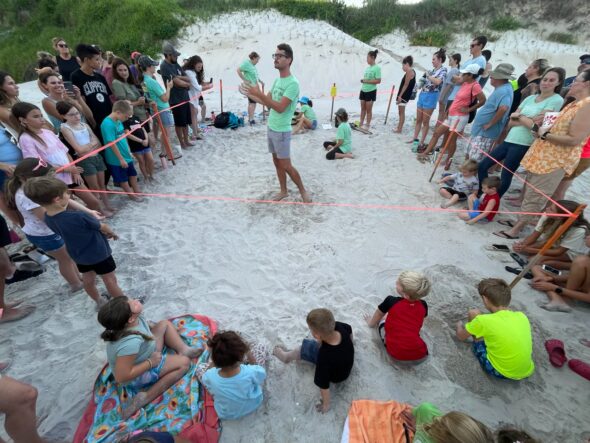
“I needed to do a public nest evaluation on that one because the community was so into it. We ended up doing that on November 21 of last year as a thank you to the community for supporting us and following us along this nest’s journey,” Meers said.
MLTP doesn’t only identify when and where nests were laid and hatched, they also look for signs that could affect the success rate of each nest, “because it’s not only important to know how many nests we have on the beach, it’s important to know how successful those nests are and how many hatchlings they have produced,” Meers said.
Much of MLTP’s data collection is nesting data for the Florida Fish and Wildlife Conservation Commission (FWC).
“We are permitted through FWC’s agreement with the U.S. Fish and Wildlife Service to monitor 4.6 miles of beach around Mickler’s Landing in Ponte Vedra, Fla. That’s kind of how we essentially got started. But now we have grown to a little bit more than a volunteer organization with our new agreement with Jacksonville University,” Meers said.
Section 6 of the Endangered Species Act established an agreement between the U.S. Fish and Wildlife Service (USFWS) and the FWC that allows the FWC to issue permits for activities involving sea turtle conservation in Florida, a permit the MTLP renews every year to continue their work.
Meers became the lead coordinator of MLTP in 2021, and earlier this year launched Jacksonville University’s Sea Turtle Program, which has an agreement with MLTP to start additional research for the understanding of sea turtles and the community’s relationship with sea turtles.
MLTP’s partnership with Jacksonville University allows them to expand their research and data collection to better cover sea turtle populations and where they are frequently nesting. This kind of data collection can influence policy regarding construction and beach renourishment projects, helping to better protect sea turtles.
Meers described the MLTP as a “citizen science data collection because the sea turtle population in Florida is so large and wide-ranging.”
Driven by a strong interest in science and a passion to protect sea turtles, MLTP volunteers have created a very structured and as unbiased as possible data collection protocol to influence protection measures for sea turtles.
Furthermore, the work MTLP does provides an opportunity to get the community involved. MLTP allows authorized passionate community members to do hands-on work monitoring and protecting sea turtles.
Later in the nesting season, MLTP does public nest evaluations to give the public a chance to view the process of a Nest Productivity Assessment (NPA). In these public nest evaluations, hatchlings are often released when conditions are right.

MLTP’s work connects the community with sea turtles in a structured way that not only allows people to see sea turtles, but also educates them and ensures that the sea turtles remain protected and not harassed.
“I think getting the community involved is one of the key measures in the success of the conservation of any species.”


Be the first to comment on "How a Volunteer Group Protects Local Sea Turtle Populations"