By Logan Johnson
Gatorade bottles and racial slurs flew across the campus green as tension bubbled throughout the sea of students.
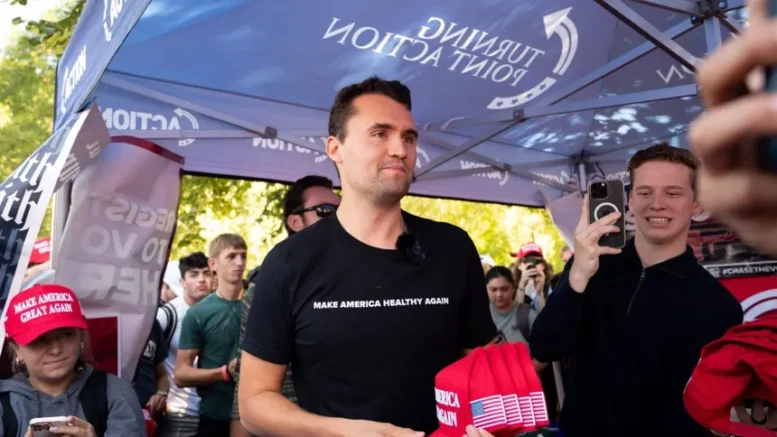
On Feb. 28, famous right-wing media personality and Turning Point USA Founder Charlie Kirk visited Florida State University as part of his “American Comeback” tour.
Kirk’s visit to campus was met with a diversity of passions. While legions of supportive students lined up to chat with the political pundit, barricaded to the side was a swath of students decrying his presence.
Although campus remained peaceful, tensions between students remained high, as chanting, counter-chanting, nazi-salutes and bigoted language permeated the event, drowning out Kirk’s presence in a sea of protest, counter-protest, and vitriol.

Protesters barricaded from the event. Photo courtesy of Joelle Nuñez.
Kirk’s controversial history of racism, sexism, homophobia, transphobia and so on, has been the focal point of the figure’s opposition. In December 2023, Kirk delivered some now infamous remarks about Marin Luther King Jr., stating that the iconic civil rights leader “was awful” and that the passage of the Civil Rights Act of 1964 was “a huge mistake.”
Comments like these are what led countless student organizations at Florida State to publicly condemn the figure’s visit.
FSU’s chapter of the National Association for the Advancement of Colored People (NAACP) released a statement condemning FSU’s decision to platform Kirk, stating that “FSU cannot claim to be a university that values diversity while continuing to welcome individuals who actively work against civil rights, gender equality and racial justice.”
Even with Kirk’s controversial history, supporters of the event cited concerns over the need for free speech and a platform of open debate, insinuating that student protest was contradictory to those values.
“We’re not opposing free speech, we’re opposing hate speech, because that threatens the well being of black students, LGBTQ+ students, and all marginalized students on campus,” said public health senior and FSU NAACP President Alysha Dorcely. “FSU allowing Kirk to have a platform doesn’t foster a culture of open debate, but endorses voices known to spread bigotry and division on campus prior.”
Other student organizations joined Dorcely and the NAACP in their opposition to Kirk. Long-standing progressive advocacy group Tallahassee Students for a Democratic Society (SDS) helped lead the protest against Kirk.
Joelle Nuñez, a transgender student organizing with SDS and studying Biology at Florida State, was right in the fray, leading chants and navigating interactions with counter-protesters, law enforcement and the occasional bigot.
Despite her confidence, Nuñez couldn’t help but feel threatened by Kirk’s presence.
Back in February 2023, Kirk insinuated that Transgender people should be ‘dealt with… like men in the 60s and 50s,’ referring to the lynching of black men. Just 7 months later in September, he called trans people a “throbbing middle finger to God.”
“[Kirk’s] very blatantly transphobic… it’s the type of thing that is easy to ignore when you’re not directly the target of them… so of course a lot of trans people are very upset about Charlie Kirk coming to campus,” Nuñez said.

Charlie Kirk (right) on California Governor Gavin Newsom’s (left) podcast “This is Gavin Newsom.” Charlie Kirk and Gavin Newsom discussed their shared views regarding transgender women and sports.
Nuñez argues that, by platforming Kirk, Florida State has indicated they’re “much more ready to support transphobia than trans students.”
Regarding Kirk’s rhetoric, she sees very real, material consequences.
“I think it’s normalizing the attack we’re seeing on diversity programs that have been won through activism,” she said.
By propagating rhetoric so flagrantly opposed to the principles of Diversity Equity and Inclusion, Nuñez sees it as easier for universities to slash these programs, thus further normalizing the propagation of hate speech.
While actions like removing ‘DEI’ words such as ‘equality’ and ‘women’ from official university publications and communications may be a silent first step, to Nuñez, these confrontations don’t stop—they keep going.
Just recently this March, the University of Florida eliminated all positions related to DEI, and reappropriated all the spending required to maintain these positions and programs to a faculty recruitment fund—effectively ending all diversity initiatives at the university, and upending the infrastructure that allowed for those initiatives in the first place.
A change in policy towards DEI programs doesn’t just impact the programs themselves, however.
During Trump’s first administration, the vast shift in federal policy regarding hot press issues like LGBTQ rights, abortion, immigration and the Black Lives Matter movement may have caused a spike in hate crime statistics.
According to an FBI report, during June 2020-notably when the George Floyd protests surged- there were 2,628 hate crime offenses. The highest single month of reported hate crime offenses during the Biden Administration was October 2024 with 1,512.
Interestingly, political science researchers from Tufts university managed to establish a link between heightened expressions of prejudice after being exposed to Trump’s rhetoric, potentially indicating that the shift in federal policy, alongside the growth of prejudiced rhetoric from the white house, may have actually manifested in more hate crimes.
As the federal shift in policy towards DEI programs worries students, and far-right political figures travel the country expressing their support for the new administration, some minority students like Nuñez and Dorcely fear for the future.
Even so, Dorcely reminds us that “if students remain steadfast in their fight for justice, things can improve.”



Be the first to comment on "Charlie Kirk Visit Leaves Minority Students Worried about Rise of Hate Speech"