

By Sophia Cardona
A thunder-like noise echoed through the island of Vieques at dusk on a Monday in 1999. It turned out to be two bombs that killed security guard Davis Sanes Rodriguez and injured four other people. They were mistakenly dropped by the U.S. Navy at the observation post where Sanes Rodriguez was working.
Judith Conde Pacheco heard the sound of the impact that day. It was a defining period for her and the Puerto Rican people, leading her to co-found the Alianza de Mujeres Viequenses (Vieques Women’s Alliance) in protest of the U.S. Navy’s presence in the island, as silence was no longer an option.
“That image of the men arriving at our shores, for us was a process — it has been, we are still managing it — a painful process of reliving very uncomfortable situations, situations of extreme violence for all of us, so we are worried,” she said.
The U.S. Navy removed its troops in 2003, but left painful memories that time cannot simply erase.
Conde Pacheco never thought she would see the day her island would once again be inhabited by the U.S. military, a fight Puerto Ricans fought for decades.
However, in September 2025, over 15,000 U.S. military troops were deployed to the island. This time, to fight what the Trump administration refers to as “drug-carrying boats” from Venezuela. The mission has reactivated bases like Roosevelt Roads Naval Base in Ceiba and Ramey Air Force Base in Aguadilla after decades of being out of use.
Little to no explanation has been released to the public, and as of Feb. 23, at least 150 people have been killed at sea in the attacks, which some label as extrajudicial killings.
For over 20 years, there was hope of dreams no longer being interrupted by the sound of bombs. Now the noise threatens its return.
“For us, it was initially a traumatic process. It was like ‘What happened here?’ We literally put our lives, our bodies in function to stop this, and before us, the women of Vieques, who had to live through that military intervention of 10,000 to 15,000 marines in their community,” Conde Pacheco said.
Puerto Rico’s Militarization: A Look Back At History
This is a tale many know all too well. Between the 1940s and the early 2000s, the sound of bombs awakened Viequenses. The U.S. Navy claimed their shores, and Puerto Ricans became spectators to military maneuvers.
Vieques, a small island to the east of Puerto Rico, fell to U.S. militarization for over 60 years. In the midst of World War II and the Cold War, the U.S. Navy had occupied over 25,000 acres of land, two-thirds of the island.
“When I got to Vieques, the first thing that caught my attention was that the beaches were off-limits for its citizens,” Conde Pacheco said.
Being from Patillas, a small town in the southeastern coast of the mainland, when she first visited Vieques she was oblivious to the militarization of the island and its implications. It was a silenced issue.
“I arrived in Vieques 34 years ago and the story of Vieques, for me, was invisible, so when I arrived…I was full of fear. I thought I wouldn’t be able to continue living there, but once I settled in, I realized the implications it had,” she said. “These people are our Puerto Rican brothers and sisters, and besides that, they are family and friends.”
By the late 1940s, as detailed in the book, “War Against All Puerto Ricans” by Nelson A. Denis, “Camp Santiago occupied 12,796 acres in the town of Salinas. Ramey Air Force Base covered 3,796 acres in Aguadilla. Fort Buchanan had 4,500 acres in metropolitan San Juan… And then there was Roosevelt Roads—the largest naval station in the world. Spread out over Vieques Island and the Puerto Rican mainland, it encompassed 32,000 acres, 3 harbors, 9 piers, 1,340 buildings, 110 miles of road, 42 of oceanfront, and an 11,000-foot runway.”
The military presence in the island at the time became the new way of life, but not one that its people were willing to accept.
Viequenses were displaced, and access to their own land was limited. From the 1940s to the early 2000s, there were approximately 200 days of bombing per year on the island, which had serious health and environmental consequences.
According to a 2019 article by The Guardian, toxic metals released in the air from bombing maneuvers resulted in a 30% higher chance of people getting cancer in Vieques compared to the mainland. Additionally, Viequenses over the age of 50 are “280% more likely to have lung cancer than other Puerto Ricans.”
“We also have to remember about things that might be less spoken about, but that had just as much of an impact on people, which is the sexual abuse and the sexual violence that women had to experience,” said Brianna Alvarado Ramos, member and spokesperson for Diaspora Pa’lante Collective.
The history of Vieques has remained in the dark far too long. Many may have forgotten, but those who remember were left with wounds that, to this day, ache.
“At one point, we had the opportunity to go to Washington, D.C. and participate in a ‘Loving for Vieques’ campaign regarding the military presence, and surprisingly, for some people who were there, Vieques was an uninhabited place,” Conde Pacheco said.
While many issues were taking place, their visibility was blocked by foreign conflicts. It was not until the death of Sanes Rodriguez that the island’s outrage became much greater and caught the attention of the people on the mainland.
“When you look back at history, the sacrifice, what the people of Vieques lived through for more than 60 years, nobody, nobody in the other towns had to experience it to the extent that the people of Vieques did,” Conde Pacheco said.
The incident unleashed large protests around the island. During the demonstrations, many were arrested, which felt as a reminder that their land did not fully belong to them and was ruled by outsiders. But hasn’t it always been that way?
The U.S. Navy arrived at Vieques soon after Puerto Ricans had endured years of brutal practices under the United States’ ruling.
One of the most traumatic events was La Masacre de Ponce (The Ponce Massacre) in 1937, carried out under the order of Blanton Winship, an American military lawyer who was Puerto Rico’s governor at the time. The massacre took place on Palm Sunday, while Puerto Ricans marched the streets to protest the imprisonment of Pedro Albizu Campos, leader of the Puerto Rican Nationalist movement, which advocated for the island’s independence. Twenty-one people: women, men and children were killed that day for supporting independence.
From 1948 to 1957, La Ley de la Mordaza (the Gag Law) banned Puerto Ricans from displaying the Puerto Rican flag and punished anyone who openly supported the idea of independence. If found guilty of any of these crimes, people could face up to 10 years in prison. Today, the Puerto Rican flag represents much more than patriotism — it is a symbol of resistance.
Caught In The Crossfire
After former Venezuelan President Nicolás Maduro was captured on Jan. 3, it seems that military operations on the island are nowhere near coming to a halt. According to U.S. military documents inspected by independent news organization, The Intercept, troops are expected to remain there at least until 2028.
While some Puerto Ricans become increasingly worried about the impact the conflict between the U.S. and Venezuela could have on their land, Puerto Rico’s Governor Jenniffer González Colón has warmly welcomed military presence.
Earlier in January, the governor expressed satisfaction about the military operations on the island, claiming possible economic, infrastructure and protection benefits.
“We are more than willing to welcome them with open arms so that they can continue working from Puerto Rico, and hopefully they will reconsider making some of these intelligence personnel permanent in Puerto Rico,” Governor González Colón said at a press conference.
While many members of the New Progressive Party (PNP) sell the same idea, Conde Pacheco believes the island’s militarization exposes the reality of constantly having to play by somebody else’s rules. Puerto Rico’s relationship with the United States is not one of mutual benefit, but one of extortion.
“The thinking of our leaders for decades has been that it is Puerto Rico’s duty to provide soldiers for the nation. They made us believe that since 1917, when they recruited for what became World War I and then for World War II, and that’s how it’s always been. Since we’re part of the nation, we all have to contribute something,” she said.
In September 2025, Governor González Colón expressed her support for the U.S. attacks against Venezuelan drug cartels during a press conference. Shortly after, the Venezuelan leader reacted by challenging her to be the first to step into the Latin American country, to which the governor humorously replied, “Who is going to attack us? Maduro’s little boat?” The statement might have been just a joke to her, but it felt more dense to Conde Pacheco, who interpreted it as adding fire to the flame.
“I feel like a hostage of U.S. policies that turn Puerto Rico into an enclave for attacking others and put us at enmity with our brother nations,” she said.
The latest U.S. involvement in Cuba might also prolong and intensify operations on the island. However, after Maduro’s capture, the next steps are unknown, at least to the public. Little to no information has been shared as to how the U.S. military will proceed with its operations on the island, something many have demanded answers to.
In November 2025, Puerto Rico’s Resident Commissioner Pablo José Hernández and Congresswoman Nydia M. Velázquez sent a letter requesting transparency of U.S. military plans in Puerto Rico to the Department of Defense. Answers to their requests have yet to be delivered.
Just when the need for information could not seem more vital, in December 2025, Puerto Rico’s governor signed the Transparency and Expedited Procedure for Access to Public Information Act into law. The law extends response times for information requests and allows the classification of information without judicial review. This is just one of the efforts by González Colón’s administration to restrict access to public information.
It is too early to determine the possible long-term impact of the island’s militarization this time around, but Lajos Szászdi León-Borja, a historian with a focus on military and naval history and professor at the Interamerican University of Puerto Rico, warns that the island could be caught in a crossfire if allies of countries such as Venezuela and Cuba retaliate.
“If the United States were to reactivate the base to the standard it had in the 1980s, well, of course, the population could potentially be in danger if a nuclear enemy in a third war decides to destroy the base, and not just by using conventional weapons, but by launching a missile and wiping everyone out. I mean, it would take the base, it would take the town,” Szászdi León-Borja said.
The Federal Aviation Administration (FAA) issued temporary flight restrictions in Ceiba, a town in the Northeast of the island, from Nov. 30, 2025 until March 31, 2026 due to “Special Security Reasons.”
“They close the airspace to avoid the possibility of espionage,” the professor said.
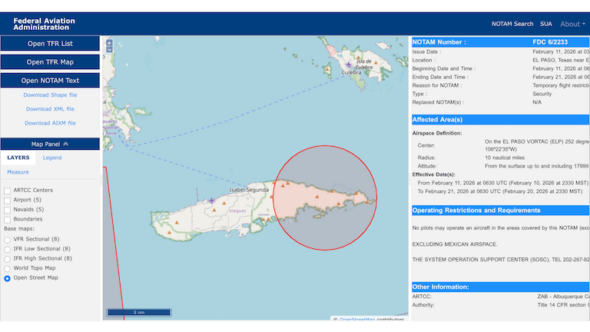
Flight advisory issued to Vieques by The Federal Aviation Administration (FAA).
The FAA also issued a temporary flight restriction from Jan. 19, 2026 to Dec. 18, 2026 to the island of Vieques “to provide a safe environment for ordinance disposal.”
The small island to the east of Puerto Rico is once again being used by the U.S. military, but this time, as a dumping ground for detonated ammunition. Vieques is home to over 8,000 people, not a landfill.
Slowly, Puerto Ricans see their island ceding to the U.S. military, as once again, it is being used as a launchpad for military operations to attack foreign countries, something its people had no say on.
Tied by the Shackles of U.S. Colonialism
Puerto Rico has been bound to the United States since 1898. Even after all these years, Puerto Ricans’ ability to exercise their rights is restricted. They have no voting rights in Congress and in presidential elections and no say over the leaders of the country to which it is submitted.
This sentiment of unfairness has been felt since its early days as a colony. In 1899, Federico Degetau, the first resident commissioner from Puerto Rico said to the U.S. Congress: “When you consider, Mr. Speaker, that these gentlemen are sent there to make laws for a country they do not know, for a people whose laws, customs, and language they do not know…you can imagine, Mr. Speaker, the probability of their doing well.”
Conde Pacheco believes the system is designed to keep Puerto Ricans submitted to the idea that remaining under colonization is their only viable option.
“In colonial systems, like the one we live in, that’s by design. The oppressor will always make us feel like we can’t, he will always make us feel inferior,” she said.
Many Puerto Ricans who are unfamiliar with the militarization of Vieques see the current military presence in the island as a means of protection and economic prosperity. However, when flipping through the pages of history, earlier events point to a not-so-optimistic story.
Mayor of Ceiba Samuel Rivera claimed that the military presence in the region would generate approximately $5 million. Economic experts say otherwise.
“There was never an economic boom under the military bases, and even less so now that is only a temporary detachment they have there,” economist José Caraballo Cueto told local newspaper, El Vocero. “The initial estimate, in my opinion, was exaggerated; even then, $5 million is not a big deal for an economy like Puerto Rico’s, which is an economy of nearly $100 billion. We’re talking about less than 0.0005%.”
Economist Adrían Alós also told El Vocero that economic development is sustained as long as the military bases remain on the island, and that not enough time has passed to declare an accurate economic impact.
“If we go back in history, the subcontractors, the private contractors, are the ones who come in, fill their pockets, and leave,” Conde Pacheco said. “Yes, bars and restaurants and food and entertainment. That’s it. That’s the economic development we have. Those are the highest-paying jobs we want?”
The Neglected Struggles of the Island
Nine years after Hurricane Maria, one of the most catastrophic hurricanes to hit Puerto Rico, the island’s power grid remains highly unstable. A Forbes article reported: “The average ratepayer in Puerto Rico experienced an average of 27 hours of power outages per year between 2021 and 2024. In 2024 alone, ratepayers went without electricity for more than 73 hours.”
In July 2025, Congressman Ritchie Torres spoke against Puerto Rico’s Financial Oversight Management Board, which bears large responsibility for the island’s economic and energy crisis.
“If Puerto Rico were a state, it would be the lowest income state in the country. And so, the tragic story of Puerto Rico is one in which the lowest-income rate payers are paying among the highest electricity bills for the worst performing electric grid in the continent, resulting in a perfect storm of energy poverty,” he said at the House Natural Resources Committee hearing.
The island’s cost of living also leaves its people behind. Many Puerto Ricans struggle to buy basic necessities, such as a pack of eggs and a loaf of bread, due to raising costs. The issue is highly influenced by the 1920 Jones Act, which makes it so that every shipment transported between two U.S. ports must be transported by U.S. vessels. This places higher price tags on imported goods.
“All of that has driven up prices, making Puerto Rico an expensive place. We have the highest income tax in the nation, we have the inventory tax. All of those costs are paid by the consumer, and that has combined to create an extremely high cost of living. Not to mention that wages haven’t kept pace with rising prices, meaning that someone earning $30,000 can’t make ends meet,” Economist Gustavo Vélez told local newspaper Noticel.
Due to economic disparities and living difficulties, many have felt forced to abandon their home. According to the Pew Research Center, as of 2021, 5.8 million Puerto Ricans were living in the diaspora. The more that leave, the more history gets left behind.
In Puerto Rico, the economic and energy crisis keeps people from dreaming of independence. The lack of self-sufficiency is a rhetoric heavily present in the island, one that the New Progressive Party (PNP), which favors statehood, has preyed upon.
Many do hope for an independent nation — even if that means an uncertain shift for Puerto Rico.
“If we had our independence and our sovereignty, and if we had a government that actually works for the people and cared about the people, they would not be allowing for this to happen,” Alvarado Ramos said. “What we’re seeing right now is the government of Puerto Rico under Jenniffer González being viewed as a puppet for the United States and being able to use our lands once again to get into a war that is not about drugs, but rather about oil.”
Puerto Rico’s government seems to be turning its back on the island by prioritizing American interests instead of addressing the struggles of its own people.
“We deserve to live in a place that is peaceful, and we deserve to be a sovereign and independent nation. Every place in this world has the right to be a sovereign nation, and we have not been given the opportunity,” Alvarado Ramos said. “I think there’s a lot of fear around what would have been if we were independent.”
Change is an intimidating idea that instills a sense of insecurity about whether Puerto Rico can succeed on its own.
“I can understand it, you know, it’s fear, it’s how we’ve lived through what we’ve lived through, we always have a caregiver,” Conde Pacheco said. “The system has kept us this way, making us believe it’s the truth, knowing that sometimes we feel defenseless, incapable of moving forward, but it’s for the convenience of a few, and they need it. They need to keep us this way.”
The Island’s Voices Echo Louder
The story of Vieques is a direct example of the past repeating itself, with those in power promoting a false hope of things being different this time around.
“There’s a lot of resistance that’s happening to the military being here, like different protests that are happening, day-to-day conversations about the fact that, you know, neighbors in Ceiba are waking up every morning and seeing all of these drones,” Alvarado Ramos said.
As the people look up to catch a glimpse of the strange drones flying over their skies, the hope for sovereignty becomes obstructed.
With the recent U.S. involvement in countries around the world, the debate over whether U.S. intervention is right or wrong is not quite simple, as freedom for some means the loss of freedom for others.
“Our message is that in resolving local, international, national and global conflicts, what should prevail is the space for dialogue and conversation; that military action has never been the answer,” Conde Pacheco said. “You might reach an agreement after killing how many people, after causing how much damage, after wasting how many resources? For us, that is not the solution to conflicts.”
Puerto Ricans around the island, including Sonia Santiago, founder of Madres Contra la Guerra (Mothers Against War), have taken to the streets to protest. Those who have lived through this once before are not willing to let it happen again.
“Puerto Rican mothers have not forgotten our sons and daughters in the military who were taken to Iraq under the false pretense that weapons of mass destruction existed there, a lie that was later widely exposed. Today, the same pattern is repeating itself,” Santiago said at a rally early in January against the U.S. intervention in Venezuela.
For activists like Alvarado Ramos, Santiago and Conde Pacheco, using their voices is their greatest form of resistance.
“When you have the facts, the information and the education, you don’t have a reason to be silent,” Pacheco said. “It is truly sad to think that we have to be silent.”


Be the first to comment on "The Colony Stranded in the Middle of U.S. War Plans"