
By Wylie Saviello
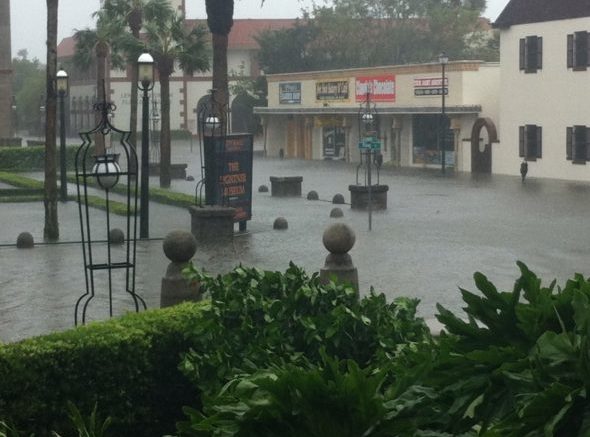
Cars causing wakes while driving through flooded streets. Restaurants closing. People wading through ankle-high water. They’re all common sights when hurricanes flood downtown St. Augustine.
But there was no hurricane, or even tropical storm, when it happened in October of 2025.
Rather, the combination of a nor’easter with high winds, king tides, and a supermoon put much of downtown St. Augustine underwater in early October last year. Several streets prone to flooding closed, as well as the Bridge of Lions. Flooding from minor weather events is becoming more common in the area, but it wasn’t always this way.
“It didn’t use to flood,” said Barbara Blonder, Vice Mayor of St. Augustine and Natural Sciences professor at Flagler, about the common occurrence of water inundating downtown during lesser weather events.
Now, as St. Augustine becomes increasingly affected by flooding, the city is developing resiliency efforts to adapt and grow with the changing flood risks. Part of this effort is the Flood Mitigation Assistance Program (FMA). The program intends to reduce or eliminate the risk of repetitive flood damage to buildings and structures under the National Flood Insurance Program.
Blonder moved to St. Augustine 24 years ago, and the streets would get wet, but not flood to the degree they do now. Her house is 110 years old, and for the first 100 years of its life, it didn’t flood. Flooding has increased significantly in recent years, causing new impacts.
“There’s no question we flood and we will flood … I worry really a lot about the historical and archeological resources that we have here,” Blonder said.
St. Augustine is prone to flooding from the usual suspects like hurricanes and tropical storms, but normal rainfall and King Tides now cause flooding too. King Tides are exceptionally high tides that occur during a new or full moon, according to the National Ocean Service. These tides get higher as the global sea level rises, meaning that even on a sunny day, streets can quickly fill with water and result in flooding challenges usually only brought on by large storms.
“This past King Tide we had here in Davis Shores, I didn’t have any water in my house, but some of my neighbors toward the end of the street, closer to the Quarry Creek area, had flooded in their house,” said local resident Erin Yates in November of 2025. “And then people drive around, and that makes it even worse because they cause wakes with their cars, and it pushes water up into people’s houses.”
Yates moved to St. Augustine in the 80s and has spent about five years living in a house in Davis Shores that her parents bought in 1994. Flood severity has changed a lot during her time here, presenting new, increasingly frequent challenges.
“The first time we ever even got water in the house was during Hurricane Matthew. Prior to that we had flooding come up the street. The house is built on a crawlspace, because it was built in the 50s, and we had water come up under the house, but it wasn’t until Matthew that we had water intrusion,” Yates said.
Hurricane Matthew was a memorable category five storm that hit Florida in early October of 2016, bringing severe flooding that many parts of the city had never seen before, emphasizing how much flood severity has increased in only the last ten years. Yates attended Flagler College in the early 2000s and remembers the extent of flooding downtown at that time.
“There have always been flooding issues for sure, but they’ve gotten much more dramatic over the years,” Yates said. “Especially downtown now, it seems to be a pretty regular thing, and I feel like every season it’s gotten to where it’s a little more and more pronounced.”
The historic Lincolnville neighborhood in the downtown area experiences significant flooding issues, something the city is trying to address through one of its biggest ongoing projects, the Lake Maria Sanchez Stormwater Project.
Funded by the Florida Department of Environmental Protection (FDEP), the project will significantly reduce existing flooding conditions throughout downtown, according to the city. It will include the construction of a new stormwater pump station, a new flood wall on the south end of the project, and the installation of several tide check valves in stormwater pipe outfalls.
“One [project] that is coming up really quickly is the Lake Maria Sanchez project … we can get a pump station on the lake and actually help drain the entire downtown area when we have flooding,” Blonder said.
The project has yet to begin construction as the city is still working to get property owners to agree to the use of their land.
“Knowing your risk factor is really important to being able to plan for [flooding],” Blonder said. “Flagler College has flooded in many parts … and will again. The college sends out king tide alerts and stuff like that to help people be prepared.”
Flooding occurs all over downtown, affecting many parts of people’s everyday lives. Flagler students wade through flooded streets on campus between classes; drivers take alternate routes that result in heavy traffic, and businesses suffer as closed roads cut off customer access.
“If tourists can’t come, if people can’t repair their homes, the economic base is hit really hard. Businesses are hit hard, you know. Restaurants have to close, hotels too,” Blonder said.
St. Augustine Fish Camp, a restaurant on Riberia Street, saw extensive flooding that caused the city to close the street, leaving customers trapped inside the restaurant and employees unable to get to work.
“Saturday morning, I worked, and we were pretty slow with business. And then it started flooding, and it crept up, but it came from both sides on Riberia right in front of us,” said Alli Chenworth, a full-time server at Fish Camp. “There was at least a foot, I would say a little bit more, of water.”
Other areas in St. Augustine see significant effects from flooding as well, like Anastasia Island.
Lynda Namie lives on the island in St. Augustine Beach, in the Surfwind and Hidden Harbour Estates area. She has suffered the impacts of new developments draining into her neighborhood, worsening the already severe flooding of homes built in the 80s.
“Our lots were graded to drain from the back of the yard to the front into a small drainage easement, and the county has allowed people to berm up the drainage easements,” Namie said.
Surrounding neighborhoods like Ocean Palms and Island Villas now drain into Namie’s neighborhood and into the historic San Julian waterway. Construction done in the Seagate neighborhood blocked her neighborhood’s water outfall, leaving water with nowhere to go once it enters the area.
While St. Augustine’s position as a low-lying city originally built without flood protection certainly contributes to the increasing flood risks, the larger catalyst is the issue of sea level rise.
“If we aren’t dealing with the sea level rise problem in terms of a global scale, it’s something we’re all going to continue to face,” Blonder said. “But the reality is, sea level rise is not slowing down. If anything, it’s not just going to continue but probably accelerate with some of the reversals on coal and other fossil fuel use.”
The city is keenly aware of the challenges posed by climate change and its position as a low-lying coastal community that is especially sensitive to the effects of future sea level rise, according to last year’s Floodplain Management Plan Annual Progress Report.
Another ongoing flood mitigation project is the Avienda Menedez Sea Wall. A Florida Department of Transportation project, the south end of the sea wall has been completed, and the north end will begin construction soon.
Streets on the bayfront experience flooding, as do others in Lincolnville, where Fish Camp is located.
Fish Camp stayed open despite the flooding that weekend in October, continuing to serve the customers already inside. Business dropped off; cars couldn’t drive onto the street to access the restaurant, and customers already inside worried about water damage to their cars and how they would leave.
“The flooding was kind of at its peak when our dinner servers would usually come into work. [The city] had the road shut down on both sides, and at first, they wouldn’t let anybody go through the water at all, so our employees are calling work saying the road is shut down and they won’t let them through,” Chenworth said.
Eventually, the police let Fish Camp employees through, and as the flooding started to go down, other cars were let through as well.
Chenworth has worked at Fish Camp for over three years and has seen severe flooding before. A major hurricane a couple of years ago stopped her from getting to work, just as it did last fall.
“I remember I tried to drive to work at that point with the hurricane, and I called and said, ‘I’m not gonna be able to make it with my car,’ and that day we actually did shut down, but I haven’t seen flooding that bad since,” Chenworth said.
For residents across the city, Hurricane Matthew serves as a marker for the increasing flood issues and puts into perspective how the city’s flood risk has changed over time.
“We never had a flood until Matthew. Seventeen years in that neighborhood with zero flooding, zero water problems … now on a good rainstorm we have flooding in the street,” said Namie.
Namie has lived in her house since 2000, though it was built in 1985, and has only had flooding issues in the last decade.
“Matthew was an anomaly, but there was nowhere for the water to go once it got in the neighborhood. There was 18 inches of water [from Matthew] … Irma the next year, I had another six inches of water, and now I have to worry about King Tides even,” Namie said.
Rising sea levels increase flooding severity everywhere, but St. Augustine has unique features that result in an especially intense amount of flooding in all parts of the city.
“In Jacksonville, you would have some flooding if there was a nor’easter or some type of event, but nothing compared to something like this,” said local resident Caity Dooley.
Dooley lives in the Santa Rosa area near the San Sebastian River, just outside of St. Augustine city limits. She has lived in Northeast Florida her whole life, most recently in Jacksonville, but just moved to the St. Augustine area two years ago.
“For example, the King Tides are very common here now… that actually floods our entire street, and that was not something I’d ever seen in Jacksonville Beach before. That was new for me,” Dooley said.
When Dooley moved here in 2023, the city was doing a drainage project in her area. Her neighbors, who had lived in the area for a while, mentioned how Hurricane Matthew and Irma brought really high water levels and were glad to see something being done to mitigate the issue.
“They were ripping up the roads, laying down pipes, and putting in sewer systems for better drainage. [My neighbors] were all really excited about the drainage project … but it still floods even with the completion of the project … residents who we’ve talked to who have lived here a very long time say it’s better, but it still floods,” Dooley said.
With such flooding come issues of cars driving through flooded streets, which, when done too fast, can cause a wake and worsen flooding impacts for surrounding buildings and homes. In June, Florida passed a No Wake Law that allows law enforcement officers to issue tickets to vehicles causing wakes on flooded streets.
But solutions will not come easily, and while the city has several smaller projects underway, the US Army Corps of Engineers (USACE) Jacksonville District is working on something bigger.
The Back Bay Coastal Storm Risk Management Feasibility Study’s purpose is to reduce the risk of future coastal storm damage in St. John’s County, according to the USACE. Through a 50-year analysis period from 2035-2085, the study will look at using engineering strategies to combine living and built solutions that try to reduce erosion, build coastal resiliency, and manage flooding impacts to the local economy.
“This is a team effort,” said U.S. Army Corps of Engineers Jacksonville District Deputy Commander Maj. Matthew Westcott in a Dredge Wire article, which is a news source covering global dredging, ports and harbors, and marine and offshore infrastructure. “When flooding impacts Florida communities, our mission is to provide technical and operational support to local partners to help reduce risk and restore normalcy as quickly as possible.”
Officials hope projects like the Back Bay Study and other initiatives throughout St. Augustine will help the city deal with both hurricanes and other weather events like the one in October 2025. That event wasn’t even a hurricane, further showing how the intensity of minor weather events is causing increasingly negative impacts on a low-lying flood-prone city.
Blonder says there also needs to be more recognition that climate change is causing these previously unusual events to happen more frequently.
“The cause [of the increased flooding] is climate change. The rain events used to pass through; now they sit on top of us and dump rain. Hurricanes are more intense; they’re pushing more water and having more energy,” Blonder said. “The root of all of it is climate change.”

Be the first to comment on "St. Augustine searches for new solutions to downtown flooding"