

By Holly Hearn
Flagler College added the cinematic arts major three years ago- and since then they have developed a new way of teaching through their film project “A Book of Freedom: The Confessions of Francisco Menéndez.”
Led by Communications Professor and Coordinator of Cinematic Arts Tracy Halcomb, PhD., and Visiting Filmmaker and Director Jim Gilmore, students in the program were able to get both class and IMDB credits through this hands-on experience. It has even been recognized for awards such as the Award of Excellence in the Faculty Mixed/Pedagogical Category at the Broadcast Education Association Festival of Media Arts competition.
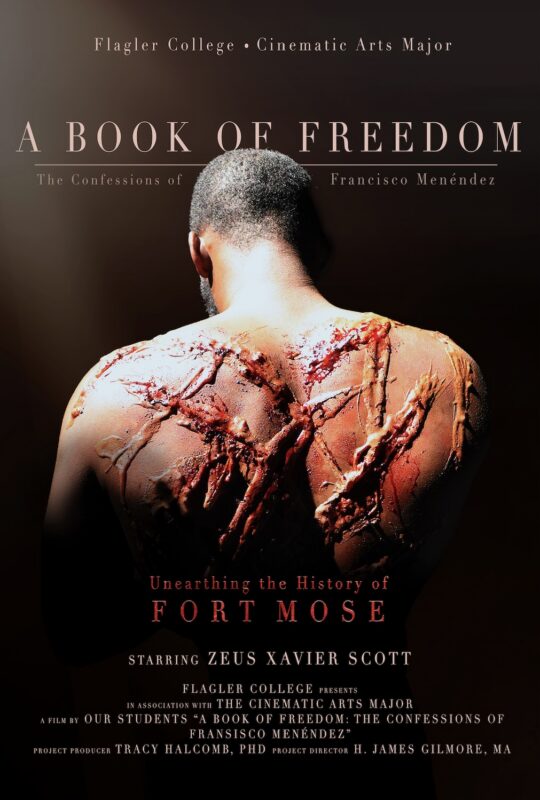
By telling the story of Francisco Menéndez, a former slave who escaped to Spanish Florida, students created a docudrama that showed how Menéndez led the first free-black settlement in the United States at Fort Mose, providing freedom in exchange for military defense, located just 10 minutes from Flagler’s campus.
“The whole purpose of the film project was to replicate a real movie set for the students and teach them set etiquette, to teach our students about all the different jobs and how they fit together,” Halcomb said.
The film has always been student-focused. Pre-production began in summer 2023 with heavy research for historical accuracy and eight students creating an outline and beginning of the script. This would become the project focus for cinematic arts students for many semesters to come.
Junior Izzy Swyt began working on the “A Book of Freedom” in the middle of her freshman year.
“Having the opportunity to gain hands-on experience with professional equipment gave my skills a major jump start and provided a strong foundation for my future classes and projects,” she said.
Flagler gave the film a budget of $50,000 to span the three-year period, allocating less than $17,000 per year.
“That’s everything. All the travel, that’s props, costumes, makeup, trying to feed the crew when there’s 30 people there,” Halcomb said. “It’s all dependent on students figuring out how to do more with very little. The students were excellent with that.”
Staying within this amount throughout all the production stages was a lesson in itself.
“It taught me strong problem-solving skills and the importance of perseverance,” Swyt said. “When challenges or unforeseen circumstances came up, we had to find solutions ourselves and keep pushing forward. Learning how to adapt and stay determined is one of the most important parts of working on a film.”
With a creative opportunity such as this, students from Flagler’s cinematic arts and theater programs alike were able to be pushed beyond their normal short film or stage production and develop skills through a story they could all connect with on some level or another.
“I thought this particular project was right on par, especially being a black male myself getting to tell the story about a black male hero in a city that I live in. I think that just kind of added a value to my senior semesters that I couldn’t really get anywhere else,” said Flagler alum Zeus Xavier Scott, who played Francisco Menéndez.
The cinematic arts program began strongly and became an example for giving students first-hand experience in their career path and pushing them outside of what they were familiar with.
Gilmore stressed the need for students to understand- and appreciate- each role on the set, a life lesson that many can forget in the film world.
“There is no unimportant role in set life. There’s different roles and different responsibilities,” he said. “Obviously, some people get more praise than others because cinematographers often get more fame than grips. But it doesn’t happen without the grips.”
This teaching mindset ended up being invaluable to the students throughout the production.
“Knowing that my professors trusted me enough to allow me to operate the camera, work with props and more, helped me strive to work hard every day,” Swyt said. “It immediately immersed me in the type of work I love and helped me gain real experience much earlier than I expected. It also gave me a lot more confidence moving forward in my program because I had already been exposed to the collaborative and technical aspects of filmmaking.”
Awards aside, the student crew recognized that the connection to the project after putting in lots of time and effort meant so much.
“You begin to develop a genuine love and passion for the film, which makes the final result even more rewarding. Seeing everything come together after so much hard work was incredibly fulfilling,” Swyt said.


Be the first to comment on "Flagler cinematic arts students learn beyond the classroom through “A Book of Freedom”"